Drywall Taping & Finishing Guide
Level 4 vs Level 5 Drywall Finish: Which Do You Need?
The difference between these two is invisible in most rooms and glaring in a few. Knowing which is which is worth real money.
Published August 2026 by Shreveport Drywall Pro
Quick answer
Level 4 for flat paint in normally lit rooms. Level 5 where you are using satin or semi-gloss, a dark saturated colour, or where a wall takes strong side light from large windows. The difference is porosity, not flatness, and it is invisible until sheen or raking light reveals it.
What the levels actually are
Drywall finish quality is not subjective. The Gypsum Association defines six levels, 0 through 5, in its GA-214 document, and ASTM C840 governs how gypsum board is applied. Almost no residential quote names a level, which is why comparing bids is so difficult.
| Level | What it is | Where it belongs |
|---|---|---|
| 0 | No finishing at all | Temporary construction |
| 1 | Tape set in compound, no further coats | Concealed spaces above ceilings |
| 2 | One coat over tape and fasteners | Garages, under tile |
| 3 | Two coats, no skim | Under heavy texture only. Not acceptable under paint alone |
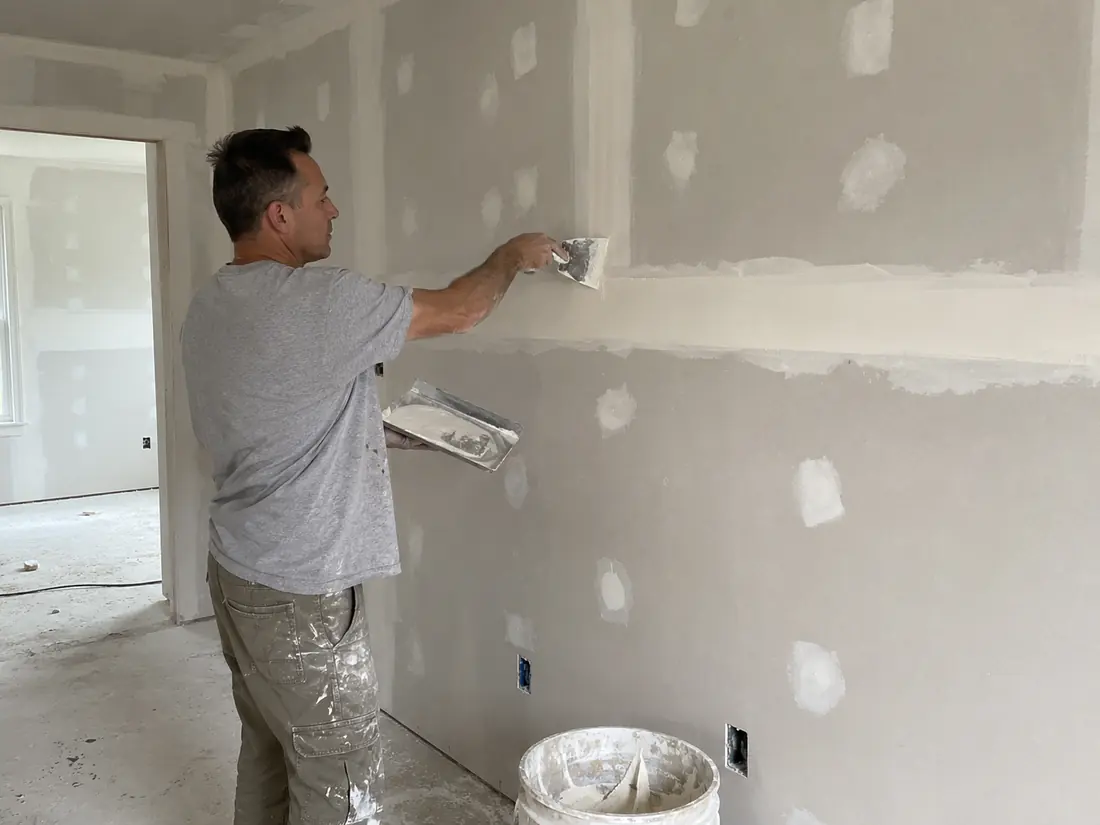
| 4 | Three coats, sanded smooth | Standard residential. Flat paint or light texture |
| 5 | Level 4 plus a skim coat over the whole surface | Gloss paint, dark colours, raking light |
The practical decision is almost always between 4 and 5.
The real difference, and it is not flatness
Here is the part that is usually explained wrong. A properly executed Level 4 wall is flat. The joints are covered, the fasteners are covered, and the surface is sanded smooth. So why would anyone pay for more?
Because flatness is not the problem Level 5 solves. Porosity is.
Bare gypsum board and dried joint compound are different materials, and they absorb paint at different rates. On a Level 4 wall, the areas covered in compound, meaning every joint and every fastener, drink paint differently from the bare board between them. Under flat paint in a normally lit room, that difference is invisible. Under sheen, or under light raking across the wall from a window, it reads as a visible pattern tracing every joint and screw, even though the wall is perfectly flat.
This effect has a name in the trade: joint banding, or photographing. A Level 5 skim coat covers the entire surface in a thin layer of compound so the whole wall has uniform porosity, which removes the effect entirely.
When Level 5 is worth paying for
Three conditions. If any one applies to a room, Level 5 earns its cost there.
1. Sheen above flat
Satin, eggshell, semi-gloss and gloss all reflect light directionally, which reveals porosity differences. The higher the sheen, the more obvious.
2. Strong side light
A wall running alongside a large window, or lit by wall sconces or directional fixtures, takes light at a low angle. That is the lighting condition that finds everything. A room with a west-facing wall of glass is the classic case: it looks fine all morning and shows every joint at four in the afternoon.
3. Dark or saturated paint colours
Deep colours show surface variation far more than light ones. A charcoal accent wall on a Level 4 finish will frequently show joint banding that the same finish under off-white would hide completely.
Outside those three conditions, Level 4 is the correct specification and Level 5 is money spent on something nobody will ever see.
Deciding room by room
The upgrade does not have to be all or nothing, and treating it that way is how people overspend.
| Room | Usually correct | Why |
|---|---|---|
| Main living area with large windows | Level 5 | Raking light, often satin paint |
| Feature or accent wall in a dark colour | Level 5 | Saturated colour shows variation |
| Bedrooms, flat paint | Level 4 | Nothing to reveal the difference |
| Hallways, flat paint | Level 4 | Rarely side-lit |
| Bathrooms with semi-gloss | Level 5 on lit walls | Sheen reveals joints |
| Closets, utility, garage | Level 4 or lower | Nobody is looking |
| Ceilings, flat paint | Level 4 | Usually lit from below, not across |
A useful rule: stand in the room at the time of day it gets the most side light, and look along the wall rather than at it. If you can see where the light grazes the surface, that wall is a Level 5 candidate.
Cost, and the cheaper alternative
The other common reason people end up paying for a full skim is wallpaper. Stripping it usually tears the drywall face, and the repair that follows is priced the same way this one is.
Level 5 adds a full skim coat of material and labor across every surface, so it is a meaningful addition rather than a small upcharge. Specifying it in the two or three rooms that need it rather than throughout is where the saving is.
There is also a genuine alternative worth knowing about: a light texture. Orange peel or a fine knockdown breaks up reflected light and hides porosity differences without any skim coat at all. It is cheaper than Level 5 and more forgiving of future repairs. The trade-off is that smooth walls are the current preference in higher-end interiors, so it is an aesthetic decision as much as a budget one. See orange peel vs knockdown texture.
Whichever you choose, the important thing is that it is named in writing. Our drywall taping and finishing quotes state the level room by room, which also makes competing bids comparable.
The bottom line
Level 5 is not a better wall, it is a different solution to a specific problem: porosity showing under sheen or raking light. In a flat-painted bedroom it buys you nothing.
Shreveport Drywall Pro specifies the level room by room against your actual paint and window orientation, so you pay for it where it shows and not where it does not. We also put it in writing, which is what makes competing bids comparable.
Not sure which level your rooms need?
Tell us the paint sheen and which walls take strong window light. We specify the finish level room by room in writing so you are not paying for Level 5 in a closet.
Or call (318) 666-5548.
FAQ
Common Questions
What is the difference between Level 4 and Level 5 drywall?
Level 4 covers tape and fasteners with compound and is sanded smooth. Level 5 adds a thin skim coat across the entire surface so bare board and compound absorb paint identically. The difference is invisible under flat paint and obvious under sheen or raking light.
Do I need Level 5 throughout my house?
Almost certainly not. It earns its cost in rooms with satin or semi-gloss paint, dark saturated colours, or strong side light from large windows. In a flat-painted hallway or closet it is money spent on something nobody will see.
Why can I see the joints even though the wall is flat?
That is porosity rather than flatness. Bare board and dried compound absorb paint at different rates, so under sheen or raking light the joints show as a pattern even on a perfectly flat wall. A Level 5 skim gives the whole surface uniform porosity.
Is texture a cheaper alternative to Level 5?
Yes, and a legitimate one. A light orange peel or fine knockdown breaks up reflected light and hides porosity differences without a skim coat. It costs less and is more forgiving of future repairs, though smooth walls are the current preference in higher-end interiors.
Should the finish level be on my quote?
It should. The Gypsum Association defines these levels precisely, but most residential quotes never name one, which makes bids impossible to compare. Ask every bidder to state it in writing.