Drywall Texturing Guide
Orange Peel vs Knockdown Texture: Which Is Better?
Both are common across Shreveport housing. They behave differently when damaged, which matters more than how they look on day one.
Published August 2026 by Shreveport Drywall Pro
Quick answer
Neither is better outright. Knockdown hides wall imperfections more effectively; orange peel is far easier to match invisibly when you need a repair later. Most Shreveport homes use orange peel on walls and knockdown on ceilings, which is a sensible split.
What each one actually is
Orange peel
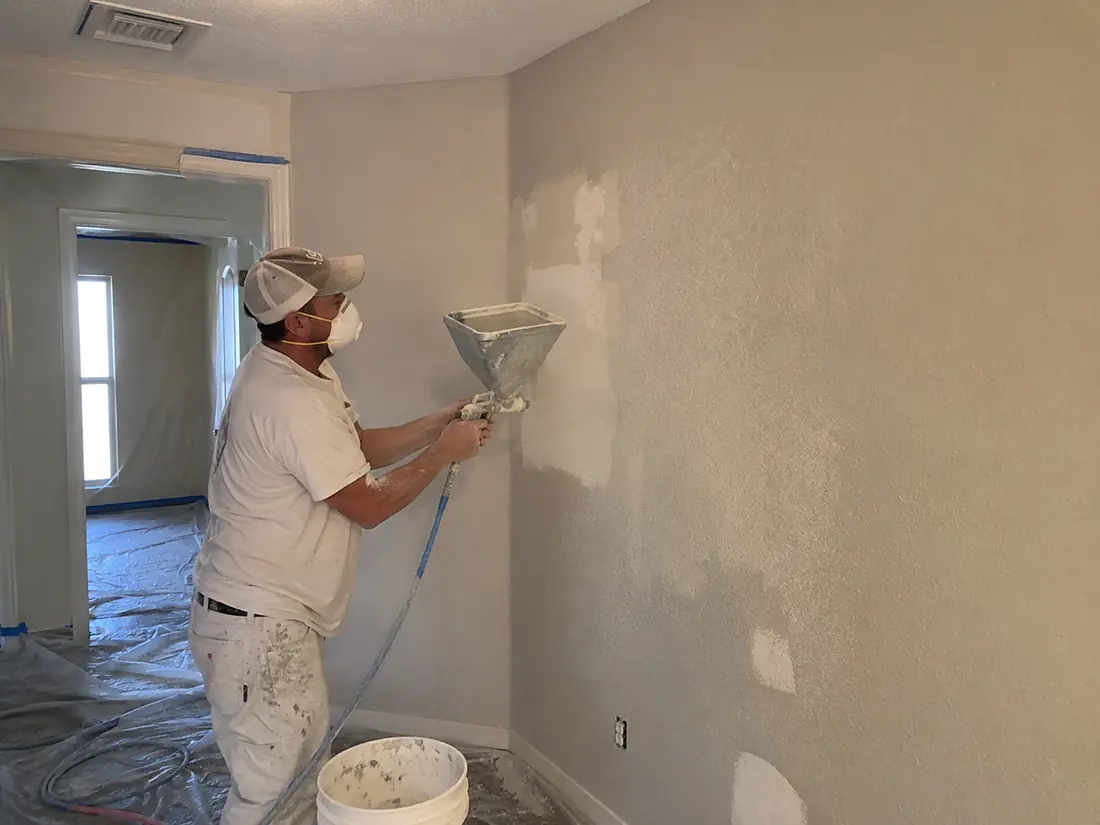
A fine, even spatter sprayed onto the wall and left alone, resembling the skin of its namesake. Thinned compound is sprayed through a hopper gun, and the droplet size and pressure determine how coarse the result is. No further working.
Knockdown
Sprayed on heavier than orange peel, then flattened with a wide blade once the compound has set just enough to hold its shape but not enough to skin over. That flattening pass, the knock down, is where the name comes from and where the whole skill sits.
The timing window is short and it moves with conditions. Pass the blade too early and you smear the pattern flat; too late and nothing flattens at all. In humid conditions the compound sets more slowly and that window arrives later and becomes less predictable, which is why knockdown is genuinely harder to get right in this climate than in a dry one.
Side by side
| Orange peel | Knockdown | |
|---|---|---|
| Appearance | Fine, uniform, subtle | Broader, mottled, more visible |
| Hides wall imperfections | Moderately | Very well |
| Application difficulty | Lower | Higher, timing critical |
| Cost | Lower | Slightly higher |
| Ease of future repair | Easiest to match | Harder, timing must be reproduced |
| Cleaning | Easier, shallower profile | Harder, catches dust in the ridges |
| Typical use here | Walls | Ceilings, sometimes walls |
What Shreveport homes actually have
Across the regional housing stock there is a fairly consistent convention: sprayed orange peel on walls with knockdown on ceilings. That combination dominates the newer subdivisions toward Benton, Haughton and Stonewall, and much of the 1990s and 2000s housing closer in.
There is a practical logic to it. Ceilings take raking light from every window and fixture in a room and are the hardest surface to finish perfectly flat, so the more forgiving texture goes there. Walls are easier to get right, so the subtler texture goes on them.
Older housing is more varied. Mid-century homes often carry heavier hand-applied textures, and in the historic districts around Highland and South Highlands original plaster walls were frequently finished smooth. Those are a different matching problem entirely, because a hand-applied texture carries the individual technique of whoever applied it and no spray rig reproduces it.
The argument that should decide it
If you are choosing a texture for new work, the question people ask is which looks better. The question that matters more over the life of the house is which one you will be able to match when something needs repairing, because something always does.
Orange peel wins this comfortably. It is sprayed and left, so reproducing it is a matter of dialling in compound consistency, nozzle and pressure until a sample board matches. There is no timing to reverse-engineer.
Knockdown is harder, because you are reproducing not just a material but a moment: how long the original installer waited before passing the blade, under conditions you cannot know. It is very achievable with sample board testing, and it is more work.
This is why an invisible repair in a Haughton or Stonewall home is a realistic expectation, while matching a 1960s hand-applied texture in an older neighbourhood is genuinely difficult. Our drywall texturing page explains the sample board process we use for both.
The third option people forget
Smooth walls with a light knockdown ceiling is the dominant preference in current remodels, and it is worth considering rather than defaulting to texture on everything.
Smooth is not a texture. It is the absence of one, achieved with a full skim coat finished to Level 5, and it is unforgiving: with no pattern to break up light, every joint and framing irregularity has to be right. It also shows scuffs more readily and is harder to repair invisibly later.
Going from an existing texture to smooth is a skim job across the whole wall, typically two or three coats plus sanding, rather than a spray job. It costs more than applying a fresh texture and it genuinely modernises a room. See Level 4 vs Level 5 for what a smooth finish actually requires underneath.
How to choose
Choose orange peel if you want something subtle, you value easy future repairs, or you are matching existing walls that already have it.
Choose knockdown if you are texturing a ceiling, the surface underneath is not perfectly flat, or you want a more pronounced look.
Choose smooth if you are prepared to pay for a Level 5 substrate and you want the current higher-end look, accepting that repairs will be harder to hide later.
And if you are matching rather than choosing, do not guess. A close-up photo in natural light is usually enough for us to identify both the texture type and whether it was sprayed or applied by hand, which determines the entire approach.
The bottom line
Choose for the repair you will need in ten years, not just the look you want this month. Orange peel is the easiest texture in residential drywall to match invisibly, and that matters more than most people expect.
If you are matching rather than choosing, send a close-up in natural light. Shreveport Drywall Pro tests every match on a sample board held against your wall before anything touches it, and we will tell you when a near-match would look worse than retexturing to a corner.
Matching an existing texture?
Send a close-up photo of your wall in natural light. We can usually identify the texture and its application method from a photograph, then test the match on a sample board before anything touches your wall.
Or call (318) 666-5548.
FAQ
Common Questions
Which texture is easier to repair, orange peel or knockdown?
Orange peel, comfortably. It is sprayed and left, so matching it means dialling in consistency, nozzle and pressure against a sample board. Knockdown also requires reproducing the timing of the original blade pass, which is harder in a humid climate.
Which texture hides wall imperfections better?
Knockdown, which is why it appears on so many ceilings. Its broader, more mottled pattern breaks up reflected light more effectively than orange peel's finer spatter.
What texture do most Shreveport homes have?
The regional convention is sprayed orange peel on walls with knockdown on ceilings, and that dominates housing from the 1990s onward. Older homes vary more, and historic-district houses often have smooth plaster.
Can I put orange peel over existing knockdown?
Not directly with a good result. The knockdown profile will telegraph through. The existing texture needs skimming flat first, at which point you are paying for the skim plus the new texture.
Is smooth better than textured?
It is the current preference in higher-end interiors, but it demands a Level 5 substrate and shows scuffs and future repairs more readily. On a ceiling whose framing is not perfectly flat, a light knockdown often looks better than a smooth finish that reveals every undulation.