Commercial Drywall Guide
What Does Commercial Drywall Cost in Shreveport?
Commercial drywall is not residential work priced higher. It is a different assembly, and the assembly is what sets the number.
Published September 2026 by Shreveport Drywall Pro
Quick answer
Standard 5/8-inch Type X partitions run roughly $3.20 to $4.80 per square foot installed, and sound-rated partitions run roughly $6.20 to $8.50, based on 2026 national commercial estimating data. Labor is 55 to 70 percent of that, materials 25 to 35 percent, and equipment such as lifts and dust containment the remaining 5 to 10 percent. The assembly you are required to build, not the square footage, is what moves the number most.
The short answer
For 2026, national commercial estimating data puts a standard 5/8-inch Type X partition at roughly $3.20 to $4.80 per square foot installed, and a sound-rated partition at roughly $6.20 to $8.50. Hanging board on metal studs on its own, without the assembly around it, tends to be quoted at $1.50 to $3.50 per square foot.
Those are published survey ranges, not a price list for this business, and they are national. Treat them as the shape of the number rather than the number. What they are genuinely useful for is spotting a bid that cannot be real, which is the more common problem on a build-out.
The reason the range is that wide is that "commercial drywall" is not one product. A warehouse demising wall and a conference room demising wall are the same square footage and a completely different scope of work.
The assembly sets the price, not the square footage
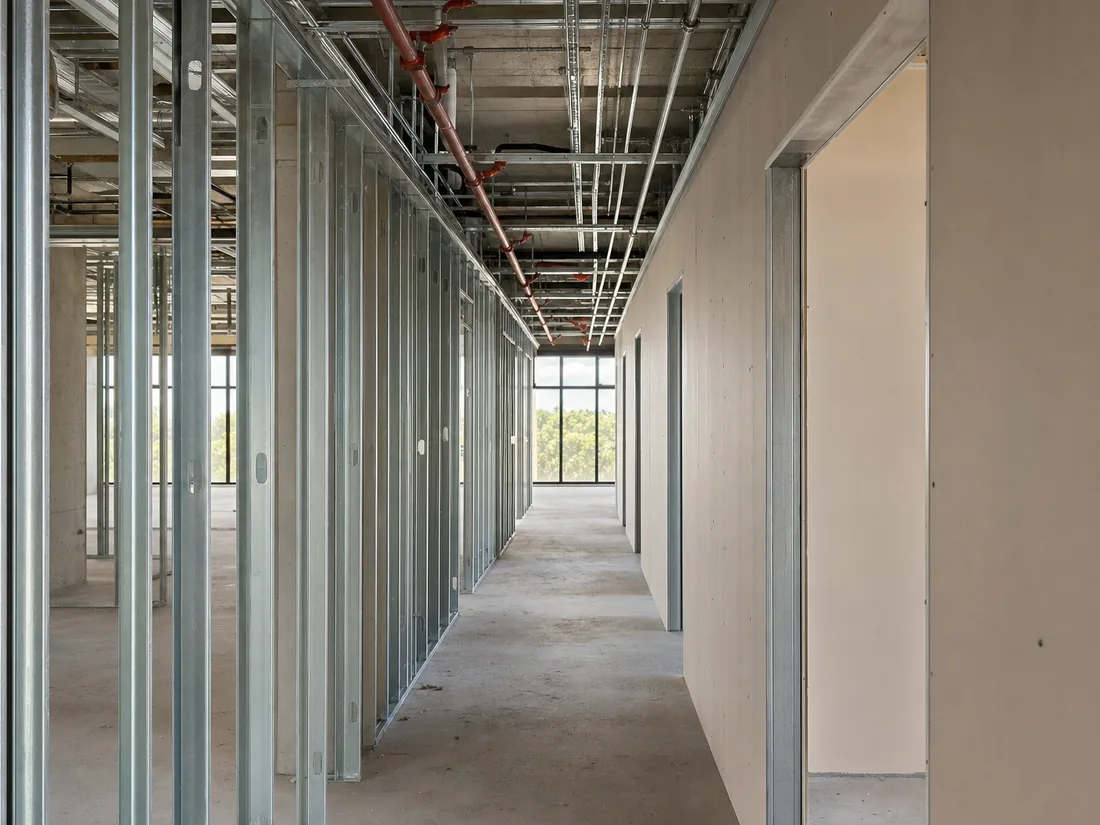
On residential work you can usually price from area and finish level. On commercial work the controlling variable is which tested assembly you are required to build, because that dictates board type, layer count, framing gauge, fastener schedule and firestopping.
Standard partition
Single layer 5/8-inch Type X each side of 25-gauge studs, taped to a Level 4 finish. This is the baseline most tenant improvement work is priced against.
Fire-rated assembly
A one-hour or two-hour rating is not a material you add, it is a tested assembly you reproduce exactly. That means the specified board, the specified stud gauge and spacing, the specified fastener pattern, and firestopping at every penetration. Substituting any component voids the rating, and an inspector who finds a non-compliant penetration will fail the wall after it is closed up.
Sound-rated assembly
Reaching a specified STC usually means resilient channel or a double-stud arrangement, insulation in the cavity, sometimes a second layer of board, and acoustic sealant at every edge. The sealant is the part that gets skipped and the part that quietly costs you the rating. Sound flanks through gaps far more readily than it passes through board.
Abuse and impact resistant
Corridors, schools and back-of-house areas often specify abuse-resistant board. It costs more per sheet and it is harder to cut and finish, so it carries a labor premium as well as a material one.
Where the money actually goes
The split on commercial work is consistent enough to be useful. Labor is roughly 55 to 70 percent of installed cost, board and finish materials 25 to 35 percent, and equipment such as lifts, scaffolding and dust containment 5 to 10 percent.
That ratio is why material-only comparisons mislead. A bid that comes in low on materials and low overall is usually low on labor hours, and labor hours on drywall are mostly finishing. Finishing is where a schedule gets made up when someone is behind, and it is where the result shows.
It is also why the equipment line matters more than its percentage suggests. Occupied-building work needs containment, negative air and daily cleanup, and a bid without those line items is either going to add them later or not do them.
Finish level is a specification, not a preference
The Gypsum Association defines finish levels in GA-214, and on commercial work the level belongs in the finish schedule room by room.
Level 4 is the normal specification for painted office walls under flat paint. Level 5 adds a skim coat across the whole surface and is what you specify for lobbies, for walls carrying gloss or semi-gloss, and anywhere strong raking light from a window wall or a cove detail will read every joint. Level 2 is appropriate above a suspended ceiling or in a warehouse where the wall is never seen.
Specifying Level 5 across an entire tenant improvement when only the lobby needs it is one of the most common ways a budget gets spent where nobody will ever look. Specifying Level 4 in a glass-fronted lobby is the opposite mistake and the more expensive one, because the fix is to skim it afterward at a worse rate.
What is specific to commercial work here
Northwest Louisiana humidity is a scheduling input on commercial jobs, not a footnote. The Gypsum Association notes that joint compound dries best between 65 and 80 degrees at 20 to 40 percent relative humidity, and that drying time can increase roughly fourfold as room humidity climbs from 50 to 90 percent. On a build-out running from August into October, that is the difference between a three-coat schedule that holds and one that does not.
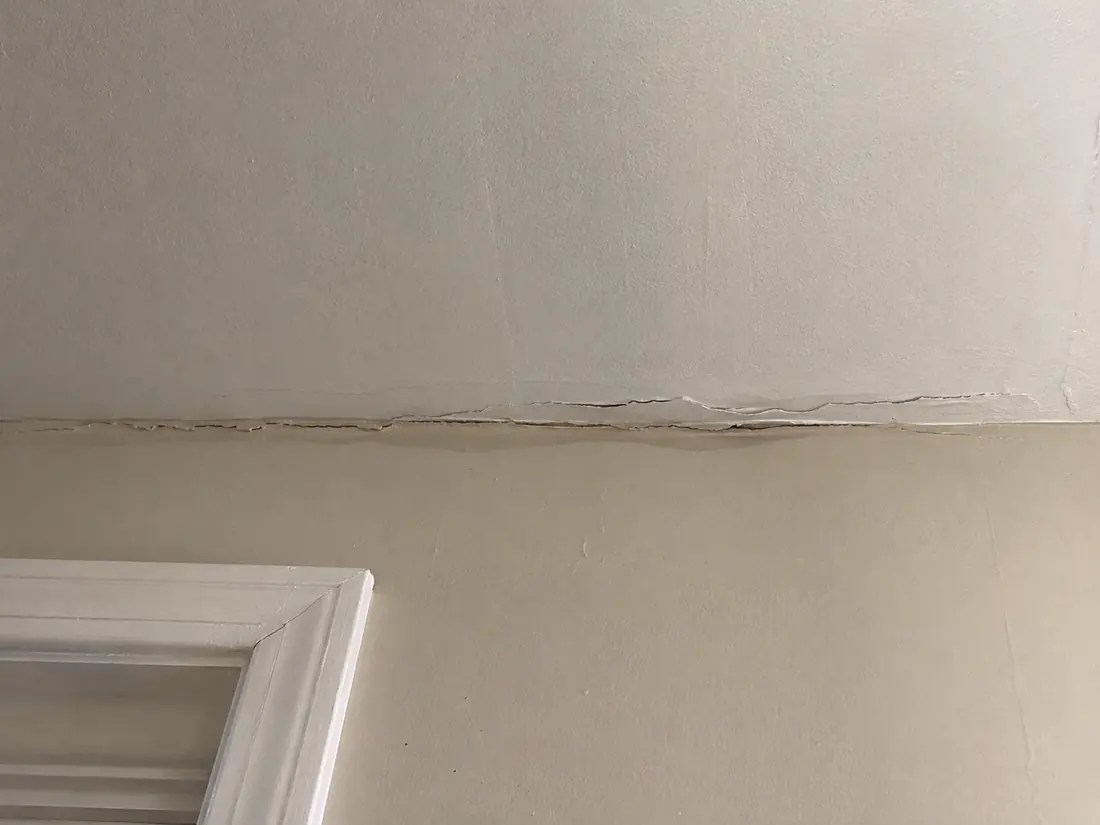
The practical consequence is that permanent HVAC or temporary conditioning needs to be part of the schedule conversation before finishing starts. Crews that push coats onto compound that has not fully dried get starved joints, and starved joints crack after the space is occupied, which is the worst possible time to be reopening a wall.
Occupied-building work is the other local reality. A lot of the commercial stock around Shreveport and Bossier City is renovation rather than new construction, which means working around tenants, after-hours access, and dust containment that actually holds. Those constraints belong in the bid. Commercial drywall priced as if the building were empty is priced wrong.
How to read two bids that are far apart
When commercial drywall bids come in 30 percent apart, the gap is almost never the board. Check these before assuming someone is cheap or someone is padding.
- Does each bid name the same assembly, including stud gauge and spacing?
- Is firestopping at penetrations included, and by whom?
- What finish level, room by room, and does that match the finish schedule?
- Is dust containment and daily cleanup in scope for occupied areas?
- Who is providing lifts and scaffolding for high work?
- Is the ceiling grid coordination included or assumed?
A bid that answers those precisely is comparable. One that gives a square foot rate and a total is not comparable to anything, and the difference will surface as change orders.
The bottom line
Commercial drywall pricing looks opaque from the outside because the number depends on an assembly most people never see specified. Once the assembly, the finish level and the site conditions are written down, the range narrows quickly and bids become genuinely comparable.
If you are pricing a build-out or a renovation in the area, Shreveport Drywall Pro quotes commercial work itemized by assembly and finish level rather than as a single square foot rate, so you can see exactly what is and is not in the number. That also covers taping and finishing scope, which is where most of the labor sits.
Bidding a build-out in Shreveport or Bossier City?
Send the wall types and the finish schedule. You get an itemized number back with the assembly, the board and the finish level written out, so you can compare it against anyone else's.
Or call (318) 666-5548.
FAQ
Common Questions
How much does commercial drywall cost per square foot?
2026 national estimating data puts standard 5/8-inch Type X partitions at roughly $3.20 to $4.80 per square foot installed and sound-rated partitions at roughly $6.20 to $8.50. Hanging board alone on metal studs is often quoted at $1.50 to $3.50. Those are published survey ranges rather than a local price list, and the assembly you are required to build moves the number far more than the area does.
Why is commercial drywall more expensive than residential?
Because it is usually a different assembly. Commercial work more often involves 5/8-inch Type X board, metal stud framing, tested fire-rated or sound-rated wall types with specified fastener patterns and firestopping, and higher access requirements. Add dust containment and after-hours scheduling in occupied buildings and the labor content rises well above a comparable residential wall.
What finish level should a commercial office be?
Level 4 is the normal specification for painted office walls under flat paint. Level 5 is worth it in lobbies, on walls carrying gloss or semi-gloss paint, and anywhere strong raking light will reveal joints. Level 2 is appropriate above a suspended ceiling or in a warehouse. The right answer is usually a mix, written room by room in the finish schedule.
Do I need a licensed contractor for commercial drywall in Louisiana?
For commercial work, the Louisiana State Licensing Board for Contractors requires a license where the total project cost including labor and materials reaches $50,000 or more for major and specialty classifications. Below that threshold a state license is not triggered, though your general contractor, your landlord or your insurer may still require one. Confirm current requirements with the LSLBC directly before you sign.
How long does a commercial drywall build-out take?
The hanging goes quickly. Finishing controls the schedule, because joint compound needs to dry fully between coats and most work needs three coats plus sanding. In a humid Northwest Louisiana stretch that can slow considerably, which is why conditioning the space matters. Any schedule that assumes same-day coats is a schedule that will produce cracking later.
Can you work around our tenants?
That is the normal case on renovation work here rather than the exception. It means containment that actually holds, negative air where warranted, daily cleanup, and often after-hours or phased access. All of that belongs in the bid rather than being discovered afterward, because it materially changes the labor hours.