Drywall Repair Guide
How Long Does Drywall Repair Take?
The work itself is quick. The drying is not, and in this climate that is the whole schedule.
Published August 2026 by Shreveport Drywall Pro
Quick answer
A small patch takes two to three days; a full room takes three to five. Very little of that is working time. Joint compound needs three coats with full drying between each, and Louisiana humidity extends every one of those intervals.
The short answer
A small patch takes two to three days. A room of new drywall takes three to five. Very little of that is someone standing in your house.
| Job | Elapsed time | Visits |
|---|---|---|
| Small hole or nail pops | 2 to 3 days | 2 |
| Medium hole with backing | 3 days | 2 |
| Crack repair, rebedded tape | 3 to 4 days | 2 to 3 |
| Ceiling repair with texture match | 3 to 5 days | 2 to 3 |
| Full room, new board | 3 to 5 days | 3 to 4 |
| Water damage, source already fixed | 4 to 8 days | 3 to 4 |
Why drying controls everything
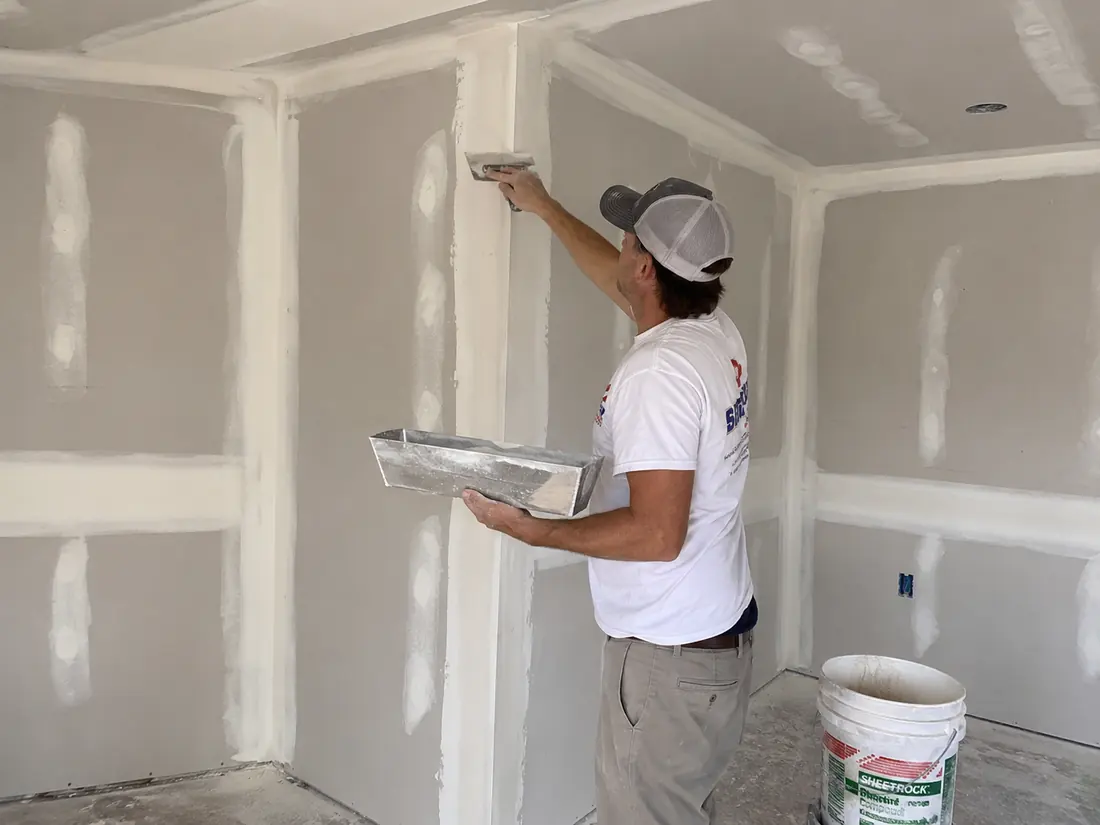
A proper repair is three coats of joint compound: tape bedded in the first, then two further coats feathered progressively wider, with sanding between. Each coat has to dry fully before the next goes on.
Compound cures by releasing its water into the surrounding air. That is not a fixed interval. It depends on how thick the coat is, how warm the room is, how much air is moving, and above all how much moisture the air is already carrying.
This is why a contractor promising a fully finished, textured and primed patch inside an hour is telling you something that cannot be true. One thick coat sanded flat will shrink as it dries and leave a visible depression, or crack along the joint within a season. The time is not padding.
What Louisiana humidity does to the schedule
This is the part national guidance never captures. Joint compound gives up water to the air, and for a large part of the year the air here is already close to saturated.
A joint that would be ready to recoat overnight in a dry January can still be holding moisture on an August afternoon. Coating over it traps that moisture under a sealed layer, and the result turns up months later as hairline cracking or visible banding along the seam once paint goes on.
Crews that produce this are rarely careless. They are working to a schedule quoted before anyone looked at conditions. The fix is to schedule coats against actual drying rather than a calendar, and where a deadline genuinely cannot move, to use setting-type compound instead.
Setting-type compound
Sometimes called hot mud, this cures through a chemical reaction rather than by evaporation, so it is far less sensitive to ambient humidity and is available in timed formulations. It is harder to work with and costs more in labor, which is exactly why it is not the default. It is the right answer on a genuine deadline, and we price it in rather than discover the problem partway through.
What a typical repair looks like day by day
For a medium hole in a textured wall:
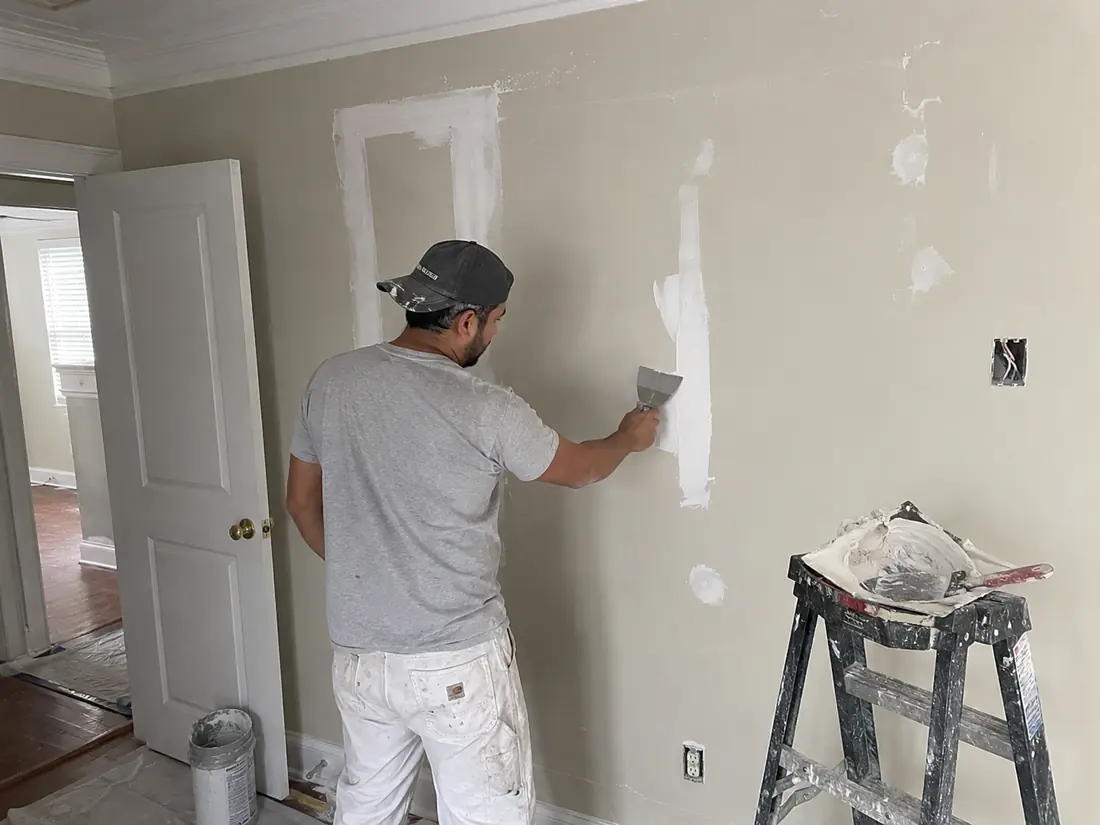
- Day one, about two hours. Protect the room, cut back to sound board, install backing, fit the patch, bed the tape and apply the first coat.
- Day two, about 45 minutes. Second coat feathered wider. Sample board sprayed for the texture match so it can be assessed alongside your wall.
- Day three, about 90 minutes. Third coat, sanding, texture applied, primer, cleanup.
Total time in your house is around four hours, spread across three days. The gaps are the job.
Bigger jobs, and why they are not proportionally longer
People often assume a whole-house job takes ten times as long as a single room. It does not, and the reason is the same drying that makes small jobs feel slow.
On a multi-room job the crew moves through the house coating one area while another dries, so the drying happens in parallel rather than in series. A single room and four rooms can finish within a day or two of each other, because the schedule is governed by the number of coat cycles rather than the square footage.
| Scope | Elapsed | Why |
|---|---|---|
| One patch | 2 to 3 days | Three coat cycles |
| Several patches, one room | 2 to 3 days | Same cycles, done together |
| Several rooms | 3 to 5 days | Cycles overlap across rooms |
| Whole house, new board | 1 to 2 weeks | Hanging adds a phase before finishing |
This is the practical argument for batching. If you have repairs in four rooms, having them done in one visit costs less and finishes sooner than four separate jobs would. Our drywall patching and hole repair service is built around exactly that, with no minimum-day charge.
What can and cannot speed it up
Helps: running the air conditioning, which dehumidifies as it cools; a fan moving air across the repair; thinner coats; setting-type compound; and batching several repairs so one dry cycle covers all of them.
Does not help: a heat gun or hair dryer, which dries the surface while the core stays wet and causes cracking; thicker coats, which take disproportionately longer; and skipping the third coat, which is where the feathering that hides the repair actually happens.
If you are on a hard deadline such as a move-out walkthrough or a listing photo date, say so at quoting stage. There is a floor on how fast this can be done properly, and it is better to know it up front. Our drywall repair in Shreveport quotes state the schedule alongside the price.
The bottom line
Almost all of a drywall schedule is drying rather than working, and in this climate that is not a corner anyone can cut without it showing up later as cracking or banding.
Tell Shreveport Drywall Pro your deadline when you call. We will say honestly whether it is achievable, and where it genuinely cannot move we price setting-type compound in rather than rushing coats and leaving you with the consequences.
Working to a deadline?
Tell us your date when you call. We will tell you honestly whether it is achievable, and when it is not we will say so rather than rush coats and leave you with cracking later.
Or call (318) 666-5548.
FAQ
Common Questions
Can drywall repair be done in one day?
A rough patch can be, but not a finished one. Three coats of compound need drying time between each, so a properly finished and textured repair spans two to three days. Anyone promising a same-day finished patch is applying one thick coat, which shrinks and shows.
Why does my repair need three coats?
The first beds the tape, the second covers it, and the third feathers the transition wide enough that it disappears. Skipping the third is the most common reason a patch is visible under raking light even though it is perfectly flat.
Does humidity really change the timeline?
Considerably. Compound cures by releasing water into the air, so when the air is already humid the process slows down. In a Gulf South summer a coat that would dry overnight in winter may need much longer, and coating over it early causes cracking later.
How long before I can paint?
Once the final coat is fully dry and sanded, and the repair has been primed. For most repairs that is the third day. Painting over compound that is not fully cured causes flashing and adhesion problems.
Can you work around my schedule?
Usually. The visits are short and spread out, so they can often be fitted around work hours. What cannot be compressed is the drying between them.