Water Damage Drywall Repair Guide
Can Drywall Be Repaired After Roof Leak Damage?
Yes, once the roof is sorted. The harder question is whether you actually have a roof leak, because in this climate half of these turn out to be something else.
Published August 2026 by Shreveport Drywall Pro
Quick answer
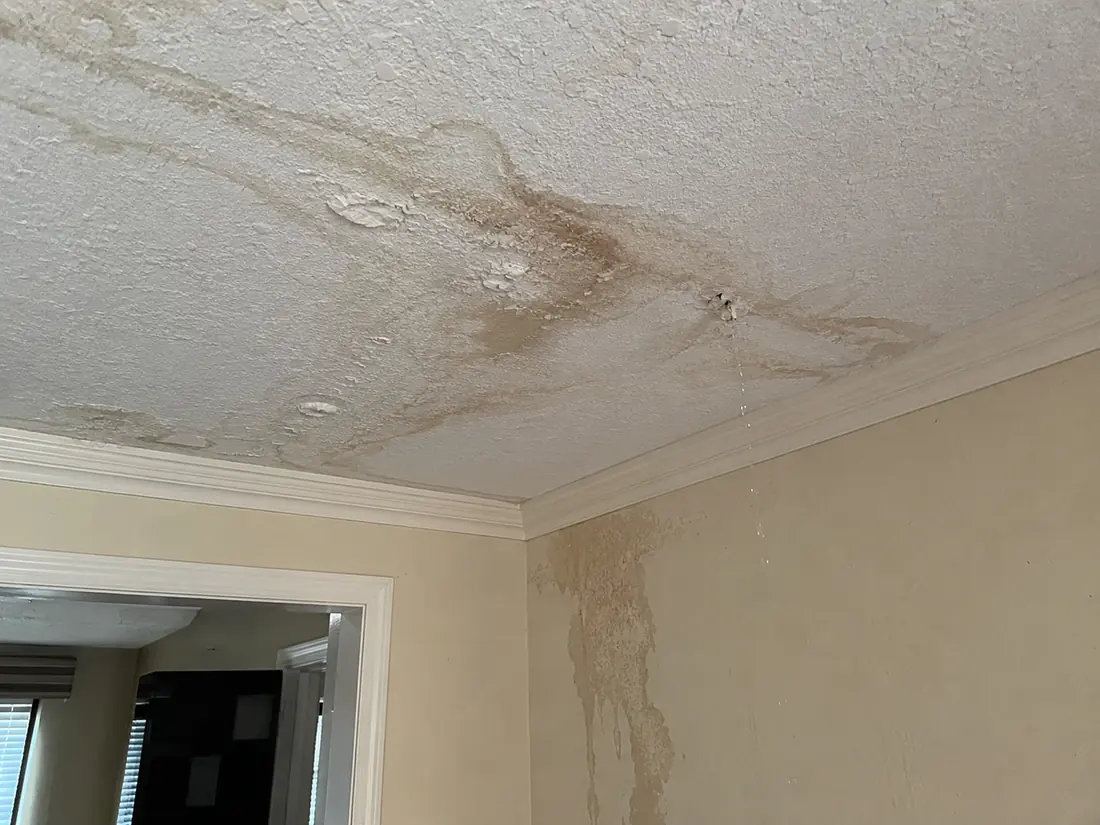
Yes, once the roof is confirmed watertight. But first check that you actually have a roof leak. In this climate much ceiling staining is attic condensation during the cooling season, which no roof work will fix. The tell is whether staining follows storms or follows heavy air conditioning use.
The stain is not under the leak
Water entering at a roof penetration does not fall straight down. It runs along the top of the ceiling drywall, follows joists and truss chords, and emerges at the lowest point it can find or wherever a fastener or seam gives it a route through.
That entry point can be several feet from where the stain appears, and on a pitched roof it can be considerably further. This is why a roofer standing on the roof directly above your stain frequently finds nothing wrong. They are looking in the wrong place, and the stain sent them there.
It also means the drywall damage is often larger than the visible mark, because the water spread across the back of the board before it came through.
Is it actually a roof leak?
Before spending money on roofing, rule out the alternative. In Northwest Louisiana, attic condensation causes a great deal of ceiling staining that gets blamed on roofs.
With a long cooling season, warm humid attic air meets cool ceiling surfaces and poorly insulated duct lines. It condenses, collects, and drips onto the board below. There is no defect to find on the roof at all.
How to tell the difference
| Clue | Roof leak | Attic condensation |
|---|---|---|
| Timing | During or shortly after rain | During hot humid spells with heavy AC use |
| Pattern | Defined stain, often ring-shaped | Diffuse damp patches, sometimes several |
| Location | Anywhere, often near penetrations | Often near or along duct runs |
| Roofer findings | Usually finds something eventually | Repeatedly finds nothing |
| Season | Storm season | Peak cooling season |
If a roofer has been out more than once and found nothing while staining continues, get into the attic on a hot afternoon and look at the duct lines and the underside of the sheathing. The fix is ventilation and duct insulation, and no amount of roof work will resolve it.
Why good roofs still leak here
Northwest Louisiana gets severe thunderstorm activity, and wind-driven rain behaves nothing like vertical rainfall. It moves sideways and upward, finding its way under shingle courses, behind flashing, past window head trim and around roof penetrations that shed ordinary rain without any difficulty.
A roof in genuinely good condition can admit water in the right storm from the right direction. That is not necessarily a defect and it does not always mean the roof needs replacing. It does mean flashing details and penetrations deserve the first look rather than the field of the roof.
Repair or replace the ceiling board?
Ceilings are less forgiving than walls here, for a structural reason as much as a cosmetic one. Gravity is a constant load, so a ceiling sheet that has lost core strength to water will sag in a way a wall never does.
Replace the affected section when the board is soft or spongy, when it is visibly sagging between joists, when staining covers a large area, or when the water ran for an extended period.
Stain-block and repaint only when a small event was caught quickly, the board is firm across its whole area, and a meter confirms it is dry. Even then, ordinary paint will not hold back a water stain. It needs a stain-blocking primer or the mark reappears within weeks.
While the ceiling is open, it is worth checking whether the board was the right specification in the first place. Half-inch board on joists at 24 inches on centre is under-specified and prone to sagging, especially where a water-based texture was later sprayed onto it. If that is what you have, replacing like for like repeats the failure. See repair or replace a sagging ceiling.
The order of operations
- Roof repaired and confirmed watertight. Not before.
- Attic inspected: wet insulation removed, framing checked, moisture readings taken.
- Ceiling opened to the moisture line rather than the stain line.
- Cavity dried and verified with a meter.
- Board replaced at the correct thickness for the joist spacing.
- Taped, three coats with real dry time, sanded.
- Texture matched on a sample board, then stain-blocking primer.
Our ceiling drywall repair page covers the diagnosis side in more depth, and water damage drywall repair covers the moisture verification.
The bottom line
Before spending on roofing, be sure you have a roof leak. In this climate a great deal of ceiling staining is attic condensation, and no amount of roof work resolves it.
Tell Shreveport Drywall Pro whether the staining follows storms or follows hot spells with heavy air conditioning use. That single detail usually separates the two, and it can save you a roof quote you did not need.
Ceiling stained after a storm?
Send a photo and tell us whether it appeared after rain or during a hot spell. That one detail usually tells us whether you are dealing with a roof leak or attic condensation.
Or call (318) 666-5548.
FAQ
Common Questions
Why is the water stain not directly under the roof leak?
Because water runs along the top of the ceiling board and follows framing before finding a route through. The entry point can be several feet away, which is why a roofer looking directly above the stain often finds nothing.
Can I just paint over a ceiling water stain?
Not with ordinary paint. Water stains bleed through it indefinitely, which is why a painted-over stain reappears within weeks. It needs a stain-blocking primer, and more importantly the source has to be confirmed stopped first.
My roofer found nothing. Where is the water coming from?
Very likely attic condensation rather than a leak. With a long cooling season, warm humid attic air meets cool ceiling surfaces and uninsulated duct lines and condenses. The tell is that it recurs with heavy air conditioning use rather than after storms.
Does the whole ceiling need replacing after a leak?
Rarely. Usually the affected section is cut back to the moisture line and replaced. A full ceiling replacement is warranted when damage is widespread, or when the existing board is undersized for the joist spacing and would sag again anyway.
How long should I wait after fixing the roof?
Until the cavity is verified dry with a meter, which can take several days in this climate. Rebuilding early is the most common reason a ceiling repair has to be reopened months later.