Water Damage Drywall Repair Guide
Can You Repair Drywall After a Plumbing Leak?
Yes, and the repair is straightforward. What is not negotiable is the order you do it in.
Published August 2026 by Shreveport Drywall Pro
Quick answer
Yes, and the sequence is not negotiable: stop the leak, map the moisture with a meter, remove wet board and insulation, verify the cavity dry, then rebuild. A slow leak is worse than a burst pipe, because the exposure ran for months rather than hours.
First: is the leak actually fixed?
This sounds obvious and it is the most common reason we get called back to somebody else's repair. Drywall is the last thing to address after a plumbing failure, and it is the first thing everybody wants fixed because it is the part you can see.
Closing a wall over an active or intermittent leak guarantees the repair fails, and it hides the evidence while the problem continues. Get the plumbing signed off first. We will not start until it is.
Burst pipe versus slow leak
These look like the same job and are not.
A burst or sudden failure
Dramatic, obvious, and often easier to deal with. A large volume of clean water arrives fast, you notice immediately, and drying starts within hours. Damage is extensive but the exposure time is short, which limits mold growth and means framing is often fine.
A slow leak
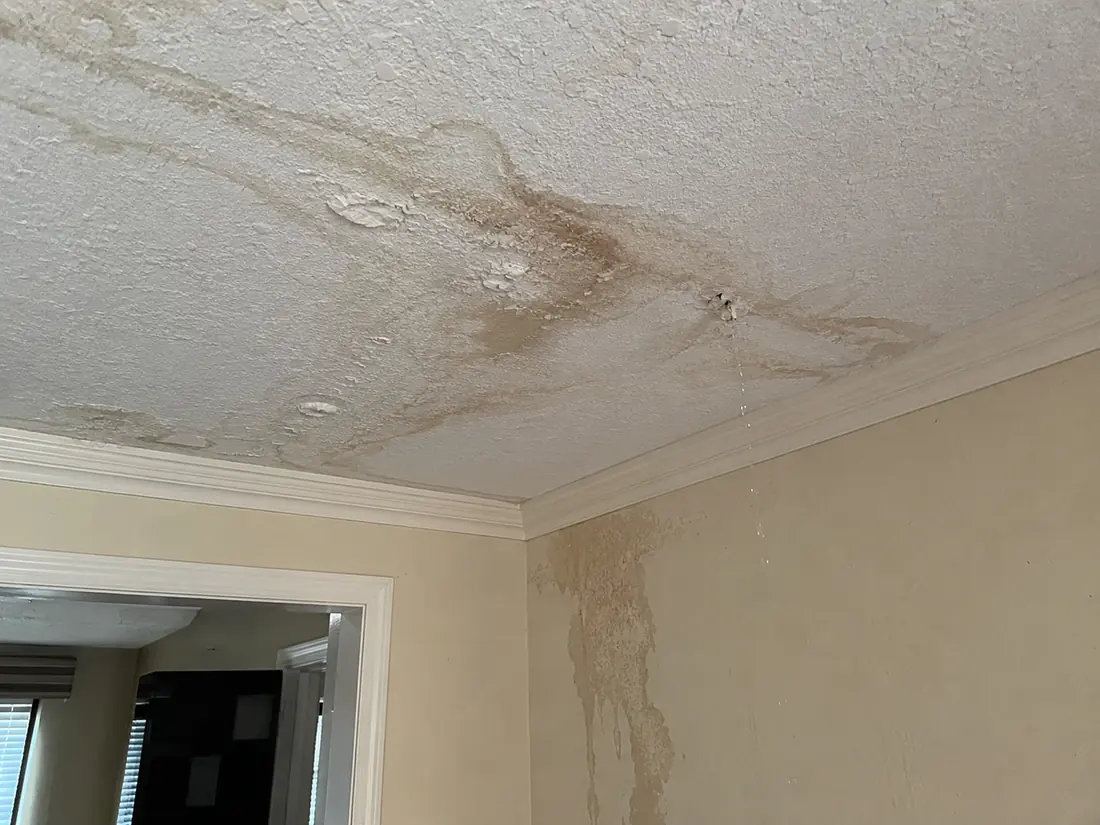
Worse in almost every way that matters. A weeping fitting behind a wall can run for months. By the time staining appears, the cavity has been damp continuously, insulation is saturated, mold has had ample time to establish and framing may have begun to deteriorate. The visible damage is smaller and the actual damage is greater.
The tells for a slow leak are a musty smell with no obvious source, paint bubbling or peeling with no staining yet, tape lifting along a seam in a bathroom or laundry wall, and a water bill that has crept up without explanation.
How far do you have to cut?
Further than the stain, always. The visible mark shows where water sat long enough to deposit minerals. Water itself travelled along the framing and through the insulation well past it.
We map the boundary with a moisture meter and cut to that line, squared off to the nearest framing members so the patch has something solid to bear on. On a slow leak that has run for months, the difference between the stain line and the moisture line can be a foot or more in each direction.
Cutting generously also serves a second purpose: it opens the cavity enough to actually dry. A small access hole in a wet wall traps moisture behind board that is still in place.
Why the insulation comes out
Homeowners often ask whether wet insulation can just be left to dry in place. In a closed wall cavity, no.
Saturated fiberglass batt compresses and loses much of its R-value, and it does not spring back. More importantly it holds moisture against the framing long after the surrounding materials have dried, which is exactly the condition mold needs. It is cheap relative to the cost of reopening the wall later.
Spray foam behaves differently and closed-cell foam in particular may be salvageable, but it also traps water against sheathing where it does get wet, which is harder to detect.
The verification step
This is what separates a repair that holds from one you pay for twice, and it is invisible in the finished result, which is precisely why it gets skipped.
Before any new board goes on, we take moisture readings on the framing and the sheathing behind the opening. A cavity that feels dry to the hand can still be holding enough moisture to cause problems once it is sealed. In this climate that matters more than it would elsewhere, because ambient humidity means a wall dries more slowly than the same wall in a dry state.
Depending on how wet things were, that can mean anywhere from a couple of days to over a week between demolition and rebuild. We would rather tell you that up front than compress it.
Rebuilding it properly
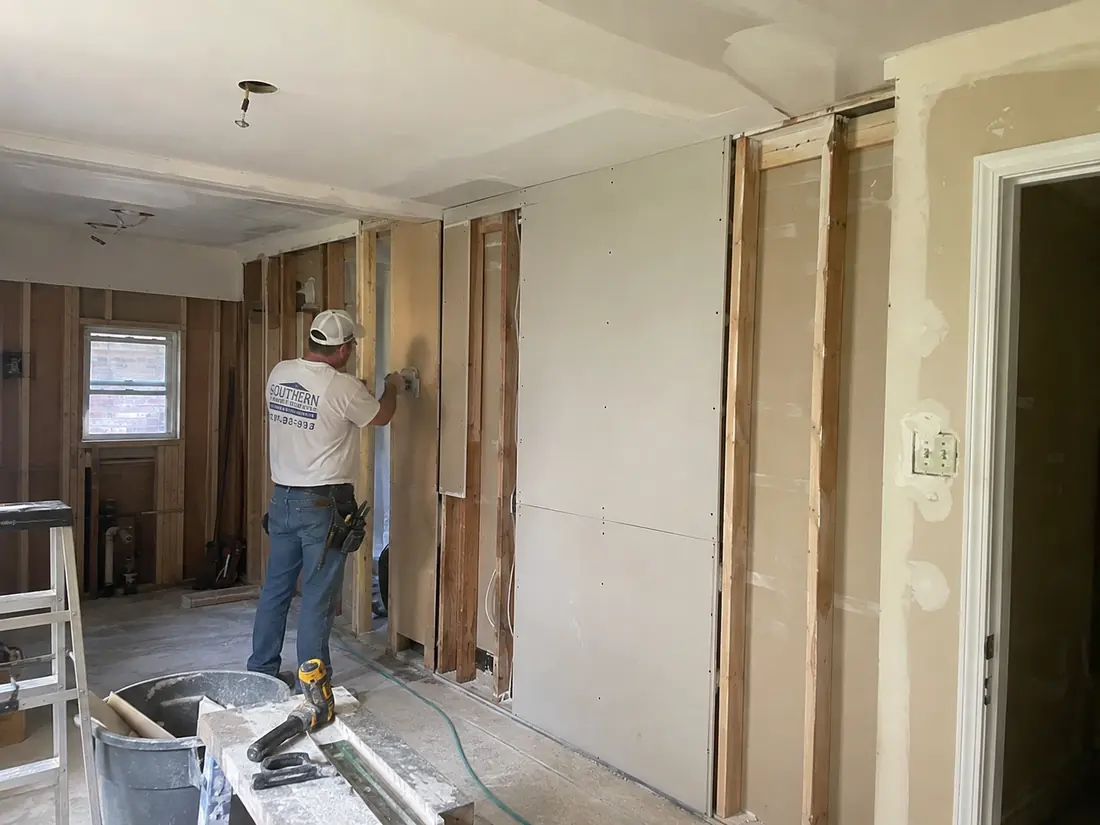
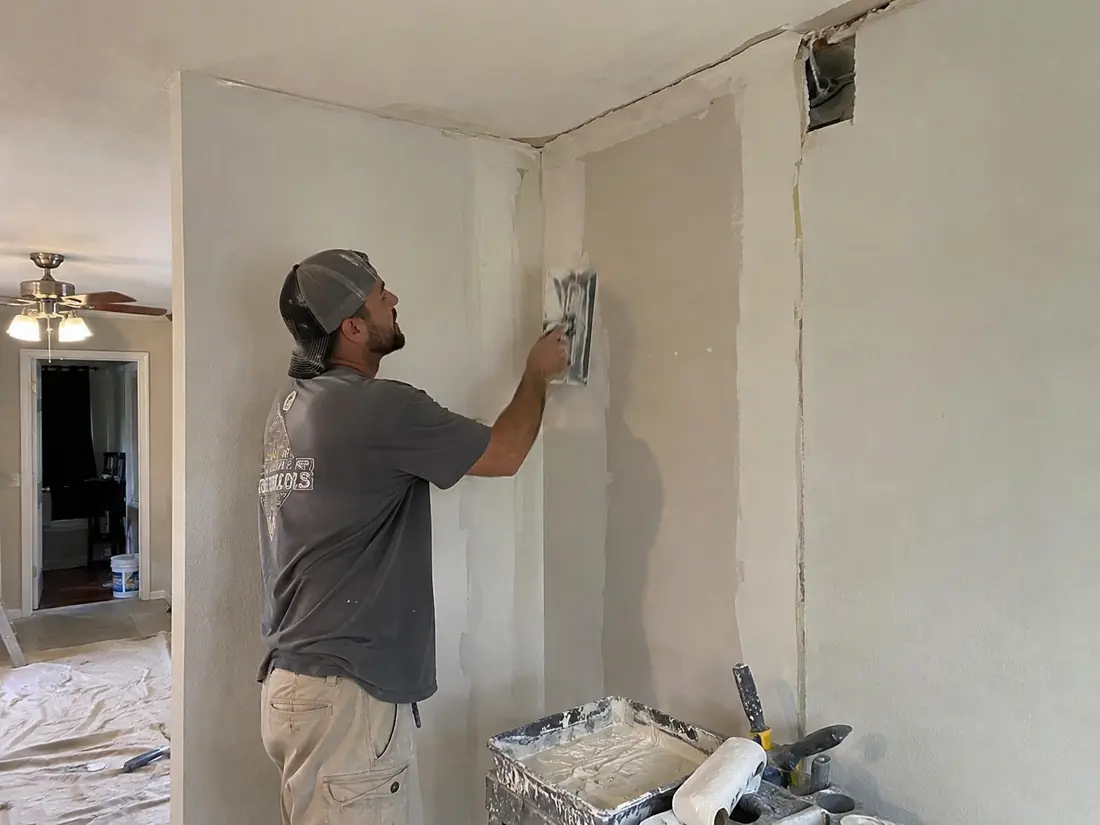
Once verified dry, the rebuild is ordinary drywall work: new board cut to the opening, screwed to the framing and any added backing, taped, three coats with real dry time, sanded, textured to match and primed.
Two specification choices are worth making deliberately. Mold-resistant board is sensible in a location that has already taken water once, particularly in a bathroom or laundry. And any previously stained area needs a stain-blocking primer, because water stains bleed through ordinary paint indefinitely, which is why a painted-over stain reappears within weeks.
Full detail on how we sequence this is on our water damage drywall repair page, and if the damage is overhead see ceiling drywall repair.
The bottom line
The drywall is the last step after a plumbing failure, not the first, however much it is the part you want gone. Source stopped, moisture mapped, wet material out, cavity verified dry, then rebuild.
Once your plumber has signed off, Shreveport Drywall Pro can take it from there, including the documentation an insurance adjuster will want while the cavity is still open.
Plumber finished? We can take it from there.
Once the leak is stopped we map the moisture, remove what is wet, verify the cavity dry and rebuild. Send photos and tell us when the plumbing was fixed.
Or call (318) 666-5548.
FAQ
Common Questions
How soon after a leak should drywall be repaired?
The removal should happen quickly, since the EPA notes mold can begin growing on damp material within 24 to 48 hours. The rebuild should wait until the cavity is verified dry, which can take days. Fast demolition, patient reconstruction.
Can I just dry the wall with a fan instead of cutting it open?
Sometimes for a very minor event, but a closed cavity dries slowly and unevenly, and insulation holds water against the framing. If board is soft or staining is spreading, opening it is the only way to know what is behind.
Does wet insulation need replacing?
Saturated fiberglass batt, yes. It compresses, loses much of its R-value and holds moisture against framing long after everything else has dried. It is inexpensive compared with reopening the wall later.
Will my repair be visible afterwards?
It should not be. The patch is taped and finished across three coats then textured to match the surrounding wall using a sample board. Stain-blocking primer stops old marks bleeding through the paint.
Do you work with plumbers?
We do not do plumbing, but we coordinate around it routinely. Get the leak fixed and signed off first, then we handle the moisture mapping, removal, verification and rebuild.